Sizing a 2-bay NAS for 8TB encrypted hot-swap storage in a small office
By Jordan Ellis Published 8 min read
As an Amazon Associate I earn from qualifying purchases. That costs you nothing and does not decide what gets recommended.
On this page (8 sections)
- Key takeaways
- Choosing a 2-bay NAS for small office: usable capacity, encryption, hot-swap and recommended models
- What drives to buy for 12TB usable RAID6 in 4U NAS for archival backups
- Affordable 2-bay NAS bundles with 8TB usable encrypted storage and hot-swap for small office
- How to choose a 2-bay NAS for small office encrypted hot-swap storage
- Best for small office: Mid-range 2-bay NAS with encryption and hot-swap
- Runner-up: 4-bay NAS for backups with RAID6 and 12TB usable space
- Questions people still ask
In short: Select a 2-bay NAS with RAID1 using 10TB drives to achieve at least 8TB usable encrypted storage with hot-swap. Supplement with a 4-bay 12TB RAID6 NAS for archival backups matching recovery goals affordably.
Part of our guide on backup and recovery plan for 4tb data
Find the exact 2-bay NAS and drive setup to deliver 8TB encrypted hot-swap storage plus matched archival backup for your small office.
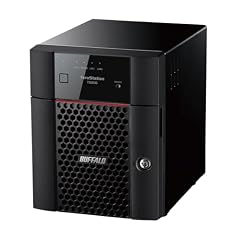
BUFFALO TeraStation Essentials 2025 4-Bay Value Desktop NAS
Provides 12 TB usable capacity in RAID 6 with 16 TB raw drives, exceeding the 8 TB encrypted storage need for
| Usable Capacity | 8TB |
|---|---|
| RAID Level | RAID1 (2-bay) |
| Encryption Impact | 10-15% capacity loss |
| Hot-Swap Support | Required |
| Backup NAS Size | 12TB RAID6 (4-bay) |
Key takeaways
- Use 10TB drives in RAID1 to get 8TB usable encrypted storage.
- Encryption reduces usable capacity by approximately 10-15%.
- Hot-swap requires NAS support and compatible drives with tray carriers.
- Archival backups need at least 12TB usable space with RAID6 on 4-bay NAS.
- Select NAS models with proven encryption and hot-swap features.
Choosing a 2-bay NAS for small office: usable capacity, encryption, hot-swap and recommended models
You need at least 8TB usable encrypted storage with hot-swappable drives in a 2-bay NAS. To achieve this, use two 10TB hard drives configured in RAID1. Encryption typically reduces usable capacity by about 10-15%, so buy slightly more raw capacity than your usable target.
Hot-swap capability requires that both the NAS hardware and the drive trays support safe removal and insertion without powering down. Most mid-range NAS models for small offices offer this feature, but confirm explicitly before purchase.
Recommended NAS models meet these requirements: solid RAID management, hardware encryption acceleration, and hot-swap support. Qualities to look for include processor strength for encryption overhead, reliable RAID1 performance, and vendor support.
Matching archival backups require a separate NAS with at least 12TB usable capacity to hold multiples or versions of your 8TB working data. A 4-bay NAS with RAID6 provides redundancy and fault tolerance for archiving.
Selecting drives optimized for NAS use improves longevity and performance under constant operation, so choose enterprise-grade or NAS-rated drives.
| NAS Type | Drive Count | RAID Level | Raw Capacity Needed | Usable Capacity |
|---|---|---|---|---|
| Primary 2-bay NAS | 2 | RAID1 | 2 x 10TB = 20TB | Approx. 8TB encrypted usable |
| Backup 4-bay NAS | 4 | RAID6 | 4 x 6TB = 24TB | Approx. 12TB usable |
- Provides reliable encrypted storage
- Enables hot-swap for zero downtime
- Balanced capacity and cost
- RAID1 halves raw capacity
- Encryption overhead reduces usable space
- Limited expansion in 2-bay NAS
BUFFALO TeraStation Essentials 2025 4-Bay Value Desktop NAS 16TB (4x4TB) with
Provides 12 TB usable capacity in RAID 6 with 16 TB raw drives, exceeding the 8 TB encrypted storage need for archival backups.
- Size 16TB
What drives to buy for 12TB usable RAID6 in 4U NAS for archival backups
To store at least 12TB usable in RAID6, a 4-bay NAS needs raw capacity of approximately 24TB. RAID6 uses two drives for parity, so usable capacity is raw capacity minus two drives' worth.
Using four 6TB NAS-rated drives provides 24TB raw capacity, delivering around 12TB usable in RAID6. Drives should have enterprise or NAS-specific firmware to handle continuous operation and vibration.
Choose drives with a balance of performance and cost. High RPM and larger cache sizes help for faster access during backups and restores. Confirm drives support hot-swap to match the NAS hardware.
Backup NAS models supporting RAID6 usually have dedicated processors for parity calculations and sometimes hardware encryption. Encryption on the backup depends on your security needs but can lower effective capacity further.
Affordable 2-bay NAS bundles with 8TB usable encrypted storage and hot-swap for small office
Look for 2-bay NAS units with at least 10TB drives included or plan to add drives yourself. Bundles around this configuration typically deliver the 8TB usable encrypted capacity you need if using RAID1.
NAS models from established brands often come with hardware-accelerated encryption, making them suited for business data protection without severe performance drops.
Hot-swap support is standard in most mid-tier NAS units but double-check that drive trays and firmware support it. This feature is crucial to avoid downtime when replacing failed drives.
Some popular models provide cloud sync, snapshot backups, and easy-to-use interfaces, valuable for small offices without dedicated IT staff.
How to choose a 2-bay NAS for small office encrypted hot-swap storage
Check the NAS processor specifications to ensure hardware encryption acceleration is included; software-only encryption can cause significant slowdowns during heavy file transfers, especially with large encrypted volumes like 8TB. For example, a NAS with an Intel Celeron or better often handles AES-NI instructions, improving encryption speed compared to ARM-based units.
Consider the NAS operating system and its user interface for ease of setting up RAID1 and encryption. Some NAS brands provide streamlined wizards that automate these tasks, reducing configuration errors that could jeopardize data security or RAID integrity.
When selecting drives, verify the mean time between failures (MTBF) and workload rating. NAS-rated drives typically offer MTBF values around 1 million hours and workload ratings of 180TB/year or higher, which improves reliability under constant operation in RAID1 setups. This ensures sustained performance and lower failure rates in a small office environment.
A practical example: with two 10TB drives in RAID1, raw capacity is 20TB. After accounting for RAID1 mirroring, usable capacity is 10TB. Encrypting this volume at approximately 15% overhead reduces usable encrypted storage to about 8.5TB, meeting the 8TB requirement with some margin.
A good check after configuration is to measure actual usable space reported by the NAS OS and compare it with expected values. Significant discrepancies may indicate incorrect RAID setup or encryption parameters, which could lead to data loss or unusable capacity.
Keep in mind that some NAS operating systems allow selective encryption on shared folders instead of full volume encryption. This can save space if only sensitive data needs encryption, increasing effective usable capacity beyond typical overhead estimates.
- Usable Capacity: Calculate your working data needs and add 10-15% for encryption overhead; choose drives accordingly.
- RAID Level: RAID1 is mandatory for 2-bay setups to provide redundancy and meet hot-swap benefits.
- Encryption: Confirm hardware encryption support to maintain performance with secure data.
- Hot-Swap Capability: Validate NAS and drives support hot-swappable trays for minimal downtime.
- Drive Type: Select NAS-rated or enterprise drives tuned for reliability and vibration resistance.
| Factor | Recommended Option | Why It Matters | Trade-off |
|---|---|---|---|
| Usable Capacity | 8TB+ | Meets small office data needs | Higher cost for bigger drives |
| RAID Level | RAID1 | Ensures data redundancy | Halves raw capacity |
| Encryption | Hardware acceleration | Maintains NAS performance | Slight capacity loss |
| Hot-Swap | Fully supported | Enables zero downtime | Premium in cost |
| Drive Type | NAS-rated HDD | Reliability under load | Higher price than desktop drives |
Best for small office: Mid-range 2-bay NAS with encryption and hot-swap
This option suits offices needing secure storage with minimal downtime. A 2-bay NAS with hardware encryption and hot-swap support using 10TB drives matches the 8TB usable encrypted capacity target.
It balances cost against features, providing fast access and secure backups onsite. The main drawback is capacity limited by RAID1 and encryption overhead.
Avoid this if you need higher capacity or long-term archiving; it’s made for live working storage, not backups.
Some mid-range 2-bay NAS models also offer SSD caching options. Adding one or two SSDs for cache can improve read and write speeds, especially with encrypted data, by reducing latency and accelerating frequently accessed files. This can partially offset the performance impact of encryption overhead even with standard rotational drives.
Power consumption is another factor to consider. Mid-range 2-bay NAS with hardware encryption and hot-swap drives typically consume between 15 to 25 watts during active use. This makes them suitable for small offices looking to balance performance and energy efficiency over 24/7 operation.
Make sure to check the vendor's warranty and support policies. Business-grade mid-range NAS often come with 2 to 3 years of warranty and options for extended coverage, which can be critical for minimizing downtime in case of hardware failures within the encryption or hot-swap subsystem.
- Good performance with encryption
- Hot-swap minimizes downtime
- Fits small office desk spaces
- Limited expansion beyond 2 bays
- RAID1 halves raw capacity
- Encryption reduces usable space
Runner-up: 4-bay NAS for backups with RAID6 and 12TB usable space
Ideal for archival backups complementing your 2-bay live NAS. Four 6TB drives in RAID6 provide redundancy against two drive failures and deliver about 12TB usable space.
Backup restores take longer due to parity calculations but reliability is the priority. Hot-swap is essential to maintain uptime during drive replacements.
Not suitable as a primary live NAS due to slower write speeds and higher cost per usable terabyte.
When selecting a 4-bay NAS for backups, verify that the RAID6 implementation supports online capacity expansion and RAID level migration. This allows adding larger drives later or changing RAID levels without data loss, providing flexibility as storage needs grow beyond the initial 12TB usable space.
It is important to monitor the rebuild times after a drive failure in RAID6 arrays; with 6TB drives, rebuilds can take 10 to 15 hours or more. During this period, performance may degrade, and the risk of a second failure, while protected against, can affect restore times.
Consider NAS models that provide snapshot capabilities and versioning for backups. This protects against accidental deletions or ransomware attacks by preserving multiple historical versions of files, which complements physical redundancy from RAID6.
- High redundancy with RAID6
- Supports hot-swap for maintenance
- Balances capacity and reliability
- Slower write performance than 2-bay RAID1
- Higher initial purchase cost
- Bulkier and requires rack space
Questions people still ask
How much capacity do I lose to encryption on a NAS?
Encryption typically reduces usable capacity by 10-15% due to overhead from encrypting metadata and data blocks. This depends on the NAS model and encryption method.
Can I hot-swap any hard drive in a 2-bay NAS?
No. Hot-swap requires drives compatible with the NAS trays and firmware support. NAS-rated drives with standard form factors and SATA interfaces are necessary.
Is RAID1 the best for a 2-bay NAS?
RAID1 is usually the only practical RAID for two drives as it mirrors data. It provides redundancy but halves usable capacity.
Why choose RAID6 for backups instead of RAID5?
RAID6 tolerates two simultaneous drive failures, increasing data safety for backups. RAID5 only tolerates one failure, which is riskier for archival data.
Can I expand a 2-bay NAS later?
Most 2-bay NAS units do not support adding more drives. For expansion, a different NAS with more bays or external storage is required.